
Start with the installed appliance
A water heater’s nominal volume describes the water it stores. It does not describe the complete load on the wall. A useful purchasing brief starts with the exact appliance model, its empty mass, its maximum filled mass and the arrangement of its mounting points. Record whether the heater is installed vertically or horizontally: a bracket that fits one orientation is not automatically suitable for the other.
Ariston’s Andris Elite installation manual assesses the appliance when filled with water and specifies a mounting requirement for that product family. Treat that as a reminder to obtain the exact appliance manual, not as a universal safety factor for every heater or bracket.
Sources: Ariston — Andris Elite / Elite Wi-Fi installation manual (product-specific requirements)
Use a weight estimate only to prepare the brief
For an initial estimate, water contributes approximately 1 kg per litre. A hypothetical 80-litre heater with a 25 kg empty mass therefore contains about 105 kg of combined appliance and water mass, before other supported parts are considered. Its gravity force is approximately 1.03 kN using 9.81 m/s². This example is a conversion exercise, not a capacity recommendation for any M Brackets model.
The distance between the load and the wall also matters. In a simplified static model, force multiplied by its perpendicular offset gives a moment. If that illustrative force acts 0.25 m from a reference support plane, the moment is about 0.26 kN·m. Real load distribution depends on the complete appliance, rail, hook and anchor arrangement; dividing the weight equally between screws is not a design check.
Separate fit dimensions from strength evidence
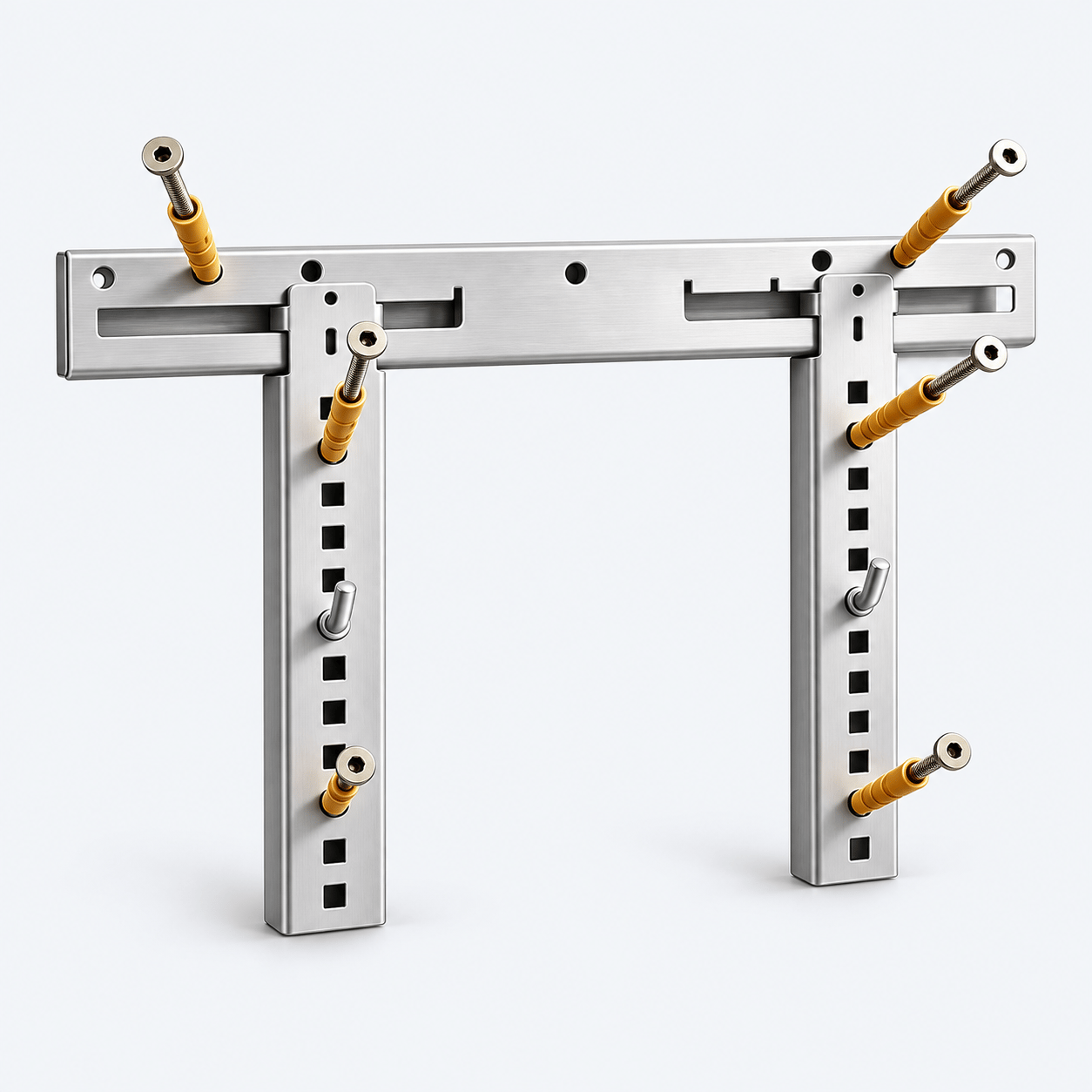
M Brackets’s U family has a stated overall size of 550 × 300 mm. US30 and UC30 use 3 mm sheet; US25 and UC25 use 2.5 mm sheet. US denotes stainless steel and UC denotes galvanized carbon steel. These are identification and dimensional facts. They do not establish a load rating, anchor capacity or compatible tank volume.
Before selecting a variant, compare the heater’s attachment geometry with a controlled bracket drawing. Overall width is not hook spacing, and the height of a product photograph is not an installation dimension. Request the connection details for the chosen model rather than assuming the four variants share the same joints.
Ask for a complete acceptance basis
An approval package should connect the intended appliance to the exact bracket and installation conditions. Where load testing is required, ask what was tested, how it was supported, where the load was applied and what constituted failure or unacceptable movement. A photograph of a weight on a rail cannot answer those questions.
The following is our proposed procurement checklist. Installation and structural verification remain specific to the equipment, substrate and project.
- Exact appliance model, filled mass and orientation.
- Mounting-point drawing, wall offset and required service access.
- Bracket model, material, thickness and connection arrangement.
- Wall construction and a separately verified anchor specification.
- Applicable test evidence, acceptance criteria and installation instructions.
Sources & scope
Manufacturer references apply to the equipment or fastening systems named in those documents. The purchasing checklists and examples are M Brackets’s editorial guidance; they do not certify a particular installation. Sources reviewed: .
Turn your requirements into a clear specification.
Send your equipment model, drawings, wall information, finish requirements and order quantity.
Discuss your requirementsU-Type model specifications